

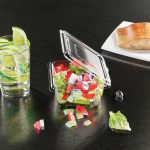
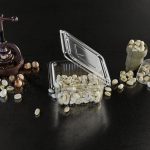
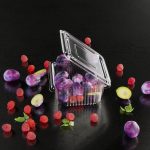
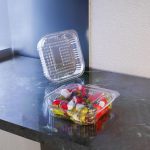
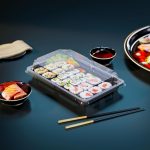
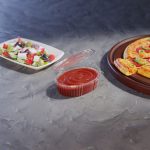
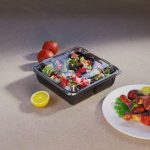
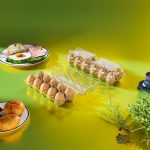
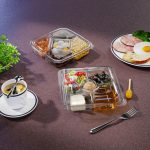
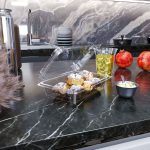

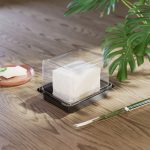

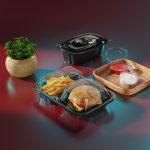
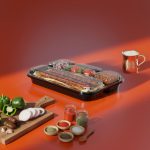
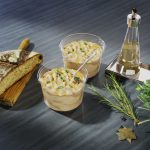
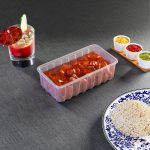



Deli containers are PP containers that carry olives, cheese, pickles and mezes on supermarket shelves and in takeaway without leaking. Dipack manufactures 150 and 200 cc soup bowls, 250, 500 and 1000 cc containers and a 500 cc deep model, and sells them wholesale direct from the manufacturer to supermarkets, delis and meze producers.
This page also covers the size table, the difference between soup bowls and rectangular containers, and the wholesale ordering process, so you can choose the right container for your shelf and takeaway needs in one go.
Deli container models and size table
The deli range has two body types: the round soup bowl and the rectangular container. The soup bowl suits soup, yogurt and single-serve mezes. Rectangular containers line up side by side on the shelf, so they take up less space in supermarket packing.
| Model | Volume | Dimensions (mm) | Pcs per sleeve / carton | Use |
|---|---|---|---|---|
| Soup bowl | 150 cc | Ø100×32 | 100 / 2000 | Single-serve meze, sauce, yogurt |
| Soup bowl | 200 cc | Ø100×35 | 100 / 2000 | Soup portion, dip, clotted cream |
| Deli container | 250 cc | 144×105×30 | 100 / 2000 | Olives, sliced cheese, small mezes |
| Deli container | 500 cc | 200×105×35 | 100 / 1200 | Standard shelf pack |
| Deep deli container | 500 cc | 144×105×58 | 100 / 2000 | Pickles, brined products, wet mezes |
| Deli container | 1000 cc | 200×105×60 | 100 / 1200 | Family-size olives and cheese |
Each product page also lists carton dimensions, carton volume (m³) and cartons per truck, so you can plan storage and shipping before you order.
Soup bowl or rectangular deli container?
The round soup bowl is easy to eat from with a spoon, so businesses use it for soup, yogurt and dip portions. The rectangular container leaves no gaps on the shelf and offers a flat surface for labels. For takeaway, choose the soup bowl; for supermarket shelves, choose the rectangular container.
- Soup bowl: for example, soup, yogurt, cacik, dips and clotted cream.
- Rectangular container: on the other hand, olives, sliced cheese, pickles, hummus and meze packs.
- Deep container: more room for brine in pickled and liquid products.
Why PP deli containers?
Dipack makes its deli containers from food-safe polypropylene (PP). PP holds its shape with brined and acidic products and withstands freezer temperatures. The locking lid keeps the container leak-proof on the shelf, so pickle brine and olive oil do not run onto the shelf.
| Feature | Dipack PP deli container | Note |
|---|---|---|
| Material | Polypropylene (PP) | Suitable for acidic and salty products |
| Lid | Locking, leak-proof | Flat top surface for labels |
| Freezer | Suitable | Stocking mezes and ready meals |
| Microwave | Suitable | Reheating soups and wet dishes |
| Pieces per carton | 1200-2000 | For high-volume shelf turnover |
How to choose a deli container: 4 checkpoints
The wrong container means leaks and label problems on the shelf. Check the four points below before you order.
- Liquid content: choose the deep model for brined products and pickles, and the standard container for dry mezes.
- Labeling: the rectangular container suits lid-top labels; for body labels, consider the taller sides of the 1000 cc model.
- Portion: 150-250 cc suits single servings, 500 cc a shelf pack, and 1000 cc a family size.
- Storage space: cartons hold 1200-2000 pieces; plan your model mix around your warehouse shelving.
Who uses deli containers?
Supermarket deli counters and meze producers use deli containers the most, because the locking lid prevents leaks on the shelf and the clear body shows the product. Restaurants also choose the soup bowl for takeaway soup, and patisseries for clotted cream and yogurt portions.
- Supermarkets and delis: shelf packs of olives, cheese, pickles and mezes.
- Meze and ready-to-eat food producers: for example, filling hummus, cacik and haydari.
- Restaurants and cafes: takeaway soup, yogurt and dips.
For smaller portions, see sauce containers; for cheese packaging, see cheese containers; for clear display packaging, see the leak-proof containers page.
Wholesale deli containers direct from the manufacturer
Dipack, a brand of Onursan Ambalaj, manufactures deli containers on its thermoforming lines at its Dursunbey factory (Balıkesir). That means you get a factory-direct quote with no middleman. Ordering takes three steps: first you send your model list and monthly quantities, then you receive samples and a quote, and then our team plans shipment by the carton.
If you need a custom branded shape, review the reference projects on the custom packaging page; Dipack handles the entire process, from mold design to series production.
Contact us for a wholesale quote and samples. We ship from our factory in Dursunbey, Balıkesir across Turkey and to export markets.
Request a quote on WhatsApp Contact formFrequently asked questions about deli containers
What material are deli containers made of?
Dipack makes its deli containers from food-safe polypropylene (PP). The container holds its shape with brined and acidic products.
Is the soup bowl suitable for soup?
Yes, the 150 and 200 cc soup bowls are designed for soup and wet dish portions. The PP body is also microwave-safe for reheating.
Which model suits pickles and brined products?
For products with a lot of liquid, choose the 500 cc deep deli container, because its 58 mm height leaves room for the brine.
Can labels be applied to the lid?
Yes, the flat lid of the rectangular containers suits labels. Still, compare your label size with the lid size; for example, the 250 cc lid measures 144×105 mm.
What is the minimum order quantity?
We take orders by the carton; pieces per carton range from 1200 to 2000 depending on the model. For regular orders, we plan by the pallet.
Do you send samples?
Yes, we send samples of the model you choose, so you can test it on your filling line and on the shelf before placing a wholesale order.
