

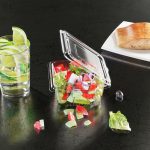

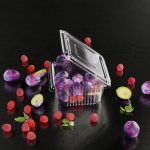
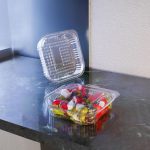
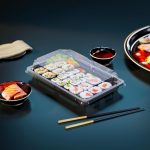
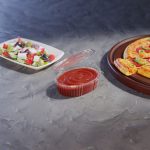

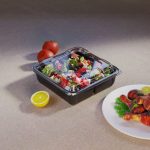

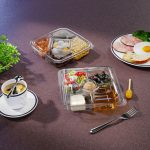



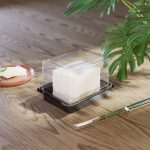

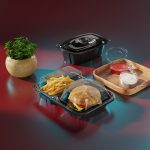
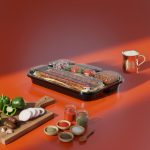
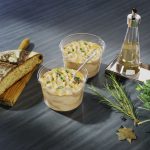
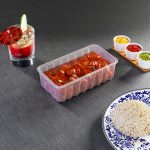




Sauce containers are small PET containers that add portions of ketchup, mayonnaise, dips and butter to takeaway orders. Dipack manufactures sauce containers from 20 cc to 150 cc in lidded, minibar and set models, and sells them wholesale direct from the manufacturer to restaurants, cafes and catering companies.
This page also covers the size table, the differences between models and the wholesale ordering process, so you can choose the right volume for every sauce on your menu in one go.
Sauce container models and size table
The sauce range has three body types: the rectangular lidded container, the minibar portion cup and the round set. Rectangular containers stand upright in the bag, which reduces the risk of leaks in delivery. The minibar cup sits neatly on hotel and hospitality trays, and the round set is the fastest model to close on filling lines.
| Model | Volume | Dimensions (mm) | Pcs per sleeve / carton | Use |
|---|---|---|---|---|
| Sauce cup | 20 cc | 64×45×20 | 100 / 3000 | Single pat of butter, jam |
| Lidded sauce container | 30 cc | 64×45×26 | 100 / 3000 | Ketchup, mayonnaise portion |
| Lidded sauce container | 50 cc | 84×60×23 | 100 / 1000 | Dips, hot sauce |
| Lidded sauce container | 80 cc | 84×60×30 | 100 / 1000 | Salad dressing, garlic sauce |
| Minibar portion cup | 80 / 100 / 150 cc | 108×80×23-40 | 100 / 1000 | Hotel hospitality, breakfast trays |
| Round sauce container + lid | 50 / 80 / 100 / 120 cc | Ø77×22-50 | 100 / 1000 | Filling lines, meze and sauce portions |
Each product page also lists carton dimensions, carton volume (m³) and cartons per truck, so you can plan storage and shipping before you order.
Which sauce cup size for which sauce?
The right volume depends first on the consistency of the sauce and on typical portion habits. Thick sauces such as ketchup and mayonnaise need only 30 cc, while salad dressing and garlic sauce need 80 cc. For spoonable products such as dips and hummus, 100-150 cc is a better portion.
- 20-30 cc: for example, ketchup, mayonnaise, butter, jam and honey.
- 50-80 cc: on the other hand, hot sauce, ranch, garlic yogurt and salad dressing.
- 100-150 cc: also hummus, dips and breakfast hospitality portions.
Rectangular sauce containers or round sets?
The rectangular lidded sauce container lines up side by side in bags and boxes, so it saves space on the takeaway counter. The round set fits automatic filling and sealing lines. As a result, restaurants that fill by hand choose the rectangular model, and producers with series filling choose the round set.
| Feature | Rectangular lidded | Round set | Minibar |
|---|---|---|---|
| Shape | Rectangular, lines up side by side | Round, locking lid | Rectangular, tray-friendly |
| Filling speed | Hand filling | Suitable for filling lines | Hand filling |
| Presentation | Takeaway and delivery | Supermarket and meze counters | Hotel and hospitality trays |
| Volume | 30-80 cc | 50-120 cc | 80-150 cc |
How to choose a sauce container: 4 checkpoints
The wrong volume means either leftover sauce or a short portion. Check the four points below before you order.
- Sauce consistency: for runny sauces, use the round set with a locking lid; for thick sauces, the rectangular lidded container is enough.
- Portion standard: set one volume for each sauce on the menu, so your stock does not get mixed up.
- Packing: for courier orders, the lidded model prevents leaks and stands upright in the bag.
- Carton quantity: small volumes come in cartons of 3000 and larger volumes in cartons of 1000; plan around your consumption rate.
Who uses sauce containers?
Takeaway restaurants and fast food businesses use sauce containers the most, because adding a standard portion to every order keeps costs under control. Hotels also use the same containers for breakfast service, and meze producers for small-portion filling.
- Restaurants and fast food: ketchup, mayonnaise, hot sauce and salad dressing portions.
- Hotels and catering: for example, butter, jam, honey and breakfast service.
- Meze and ready-to-eat food producers: small-portion filling of dips and hummus.
For larger portions, see deli containers; for salads, see salad containers; for main dishes, see the PP hot food containers page.
Wholesale sauce containers direct from the manufacturer
Dipack, a brand of Onursan Ambalaj, manufactures sauce containers on its thermoforming lines at its Dursunbey factory (Balıkesir). That means you get a factory-direct quote with no middleman. Ordering takes three steps: first you send your model list and monthly quantities, then you receive samples and a quote, and then our team plans shipment by the carton.
If you need a custom branded shape, review the reference projects on the custom packaging page; Dipack handles the entire process, from mold design to series production.
Contact us for a wholesale quote and samples. We ship from our factory in Dursunbey, Balıkesir across Turkey and to export markets.
Request a quote on WhatsApp Contact formFrequently asked questions about sauce containers
What material are sauce containers made of?
Dipack makes its sauce containers from clear, food-safe PET. Customers can see the color of the sauce, and the container holds its shape in the refrigerator.
Do lidded sauce containers leak?
The rectangular lidded container closes securely with thick sauces and stands upright in the bag. For runny sauces, choose the round set with a locking lid, because the locking channel keeps the liquid inside.
Which volume suits ketchup?
For example, a 30 cc lidded sauce container is enough for a single portion of ketchup or mayonnaise. For a double portion or salad dressing, choose 50-80 cc.
Can they hold sauces served hot?
PET suits cold and warm sauces. Bring sauces served hot to room temperature first, or choose PP containers.
What is the minimum order quantity?
We take orders by the carton; pieces per carton range from 1000 to 3000 depending on the volume. For regular orders, we plan by the pallet.
Do you send samples?
Yes, we send samples of the model you choose, so you can test it with your sauce before placing a wholesale order.
