




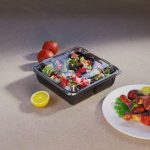

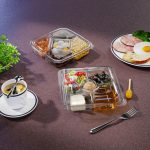






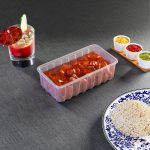


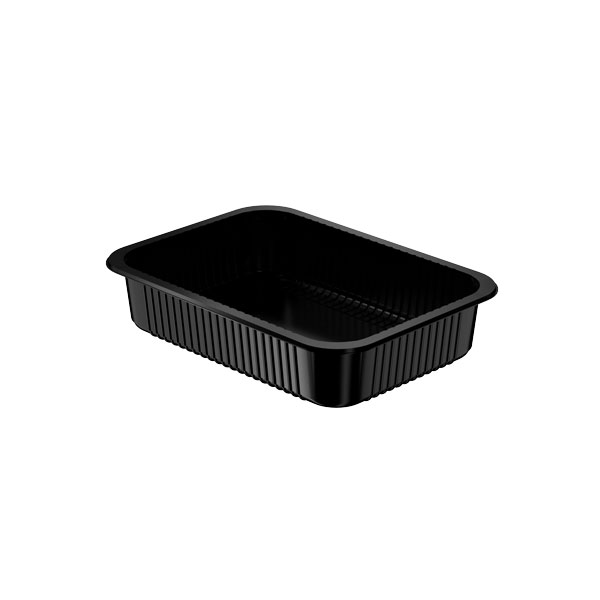


Meat trays are PP trays used to pack meat, poultry and fish with stretch film at butcher counters and in supermarket meat sections. Dipack manufactures meat trays in four base sizes and 23 heights from 12 mm to 100 mm, and sells them wholesale direct from the manufacturer to butchers, supermarkets and meat processing plants.
This page also covers the size table, which height suits which product and the wholesale ordering process, so you can choose the right tray for your counter layout in one go.
Meat tray size table: 4 bases, 23 heights
Choosing the right meat tray starts with the base size, because the base determines the film width on the stretch wrapping machine and the row layout on the shelf. You then choose the height based on pack weight. The table below shows the heights produced for each base and the carton quantities.
| Base size (mm) | Available heights (mm) | Pcs per sleeve / carton | Typical use |
|---|---|---|---|
| 190×144 | 12, 20, 30, 38, 43, 50, 55, 65, 75 | 500 / 500 | Ground meat, diced meat, chicken pieces, 250-750 g packs |
| 197×155 | 30, 45, 55 | 450 / 450 | Steak, chops, single-portion fish |
| 227×178 | 20, 40, 50, 60, 80, 100 | 300-400 / 300-400 | Family-size meat packs, chicken parts, 1-1.5 kg packs |
| 325×265 | 50, 65, 80, 100 | 120 / 120 | Whole chicken, lamb shoulder, large fish, bulk service |
Each product page also lists carton dimensions, carton volume (m³) and cartons per truck, so you can plan storage and transport directly from the product page data.
Which meat tray height for which product?
Low trays (12-30 mm) suit flat packs such as sliced products and ground meat. Medium heights (38-65 mm) are standard for diced meat, chicken thighs and portioned fish. Businesses use high trays (75-100 mm) for whole chickens, bone-in meat and marinated products.
- 12-30 mm: for example, ground meat, sliced sucuk, ham and fish fillets.
- 38-65 mm: on the other hand, diced meat, chicken thighs and wings, chops and meatballs.
- 75-100 mm: also whole chickens, lamb shoulder, marinated mixes and bulk order packs.
PP meat trays vs foam trays
Dipack makes its meat trays from food-safe polypropylene (PP). PP withstands the cold chain without cracking and holds its shape on the refrigerator shelf. Stretch film wraps tightly around the tray edge, so the pack sits neatly on the shelf.
| Feature | Dipack PP meat tray | Foam (EPS) tray |
|---|---|---|
| Breaking and crumbling | Does not break or crumble | Risk of crumbling at the edges |
| Cold chain | Freezer-safe | Suitable |
| Appearance | Smooth surface, clean presentation | Porous surface |
| Recycling | PP is recyclable | Limited |
| Size range | 4 bases, 23 heights | Usually 3-5 models |
How to choose a meat tray: 4 checkpoints
The wrong size means wasted film on the stretch wrapping machine and empty space on the shelf. Check the four points below before you order.
- Stretch film width: the base size must match the film width, so measure your machine first.
- Pack weight: choose 190×144 for 250-500 g, and 227×178 or 325×265 for 1 kg and above.
- Counter shelf depth: high trays fit fewer rows on the shelf, so take shelf height into account as well.
- Carton quantity: compare the 120-piece and 500-piece carton options against your storage space.
Who uses meat trays?
Supermarket meat sections and butchers use meat trays the most, because they can prepare stretch-wrapped packs quickly and customers buy what they can see. Meat processing plants, poultry processors and fish markets also choose the same trays for bulk packing.
- Supermarkets and butchers: ground meat, diced meat, steak and chicken piece packs.
- Meat processing plants: for example, marinated products, meatballs and skewer packs.
- Fish and poultry wholesalers: fillets, whole chickens and portioned fish.
For cooked products and takeaway, see PP hot food containers; for kebab service, see kebab containers. For mezes and deli products, deli containers are the right fit.
Wholesale meat trays direct from the manufacturer
Dipack, a brand of Onursan Ambalaj, manufactures meat trays on its thermoforming lines at its Dursunbey factory (Balıkesir). That means you get a factory-direct quote with no middleman. Ordering takes three steps: first you send your list of base sizes and heights, then you receive samples and a quote, and then our team plans shipment by the carton.
If you need a tray outside the standard sizes, review the reference projects on the custom packaging page; Dipack handles the entire process, from mold design to series production.
Contact us for a wholesale quote and samples. We ship from our factory in Dursunbey, Balıkesir across Turkey and to export markets.
Request a quote on WhatsApp Contact formFrequently asked questions about meat trays
What material are meat trays made of?
Dipack makes its meat trays from food-safe polypropylene (PP). The tray withstands the cold chain without cracking and holds its shape on the shelf.
Are the trays compatible with stretch wrapping machines?
Yes, our team designed the edge profile for stretch film wrapping. Still, compare the base size with your machine's film width, because every machine uses a different film width.
Which size suits ground meat?
For example, a 190×144 mm base with a 30-38 mm height is standard for 500 g of ground meat. For a 1 kg pack, choose a 227×178 mm base with a 40-50 mm height.
Can meat trays be used in the freezer?
Yes, PP withstands freezer temperatures, so you can use the same trays for frozen meat and chicken packs.
What is the minimum order quantity?
We take orders by the carton; pieces per carton range from 120 to 500 depending on the size. For regular orders, we plan by the pallet.
Do you send samples?
Yes, we send samples of the base and height you choose, so you can test them on your stretch wrapping machine before placing a wholesale order.
