
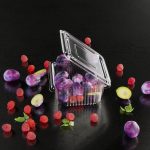
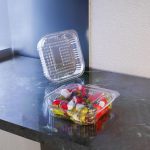
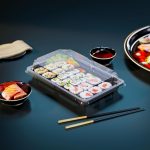
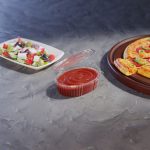


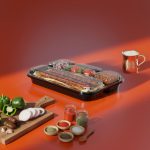


Short answer: choose a takeaway container by the food's temperature, liquid content and portion size. Use PP with a locking lid for hot and saucy dishes, and clear PET for cold food and display products. Always pack sauces separately in a sauce cup with a lid.
With online orders, food leaves your control the moment it leaves the kitchen. The container is therefore the last and most visible link in the customer experience. The meal has to arrive hot, without leaks and with its presentation intact.
We wrote this guide for restaurants, casual eateries and food businesses that run takeaway and delivery (takeout). First, we match containers to food types in a chart. We then cover leak-proofing, steam, stacking, volume and carton planning in turn.
What order should you follow when choosing takeaway containers?
Five questions lead you to the right container. Keep them in this order, because each answer narrows the next choice.
- Is the food hot or cold? Hot service needs PP; cold and display products need PET.
- Does it contain liquid? Stews, saucy dishes and soup always need a locking lid.
- How many items are in the portion? Items that must not touch go into a compartment container.
- How many cc is the portion? Measure the food first, then add headspace below the lid.
- How long is the delivery route? On long deliveries, containers that stack and do not slide come first.
Once you have the five answers, choosing the product family is simple. For example, a hot, saucy, single-item dish goes straight into a PP container with a locking lid.
Takeaway container chart by food type
The chart below matches common takeaway dishes to a container type and a Dipack product family. We took the volumes and dimensions from the technical tables on our product pages.
| Food | Suitable container | Dipack size | Product family |
|---|---|---|---|
| Stews, rice pilaf, pasta | PP with a locking lid | 500-1000 cc, 1- to 3-compartment sets | PP hot food containers |
| Soup | PP leak-proof container | 250-1000 cc | PP leak-proof containers |
| Kebab, grilled meat | 4-compartment PP tray | 420 × 300 × 53 mm | Kebab containers |
| Salad | Clear PET bowl | 500-1000 cc | Salad containers |
| Meze, hummus | Round PP container | 125-1000 cc | Hummus containers |
| Sauce, ketchup | PET sauce cup with lid | 20-150 cc | Sauce containers |
| Milk puddings, baklava | PET bowl or tray | 260 cc bowl, 500-1000 cc tray | Dessert containers |
| Sushi | PET container and lid set | 4 sizes, 6 to 24+ pieces | Sushi containers |
| Breakfast | 5-compartment PET container | 380 × 187 mm, H30, H55 | Five-compartment containers |
Which container works for main dishes, kebab and meze?
This group is usually packed in PP, because PP handles both hot filling and the cold chain. The shape of the container, however, depends on the food's consistency and the number of items.
Stews, rice pilaf and pasta
For a single dish, a single-compartment PP container with a locking lid is usually enough. If the main dish and rice pilaf travel together, choose a 2- or 3-compartment set, so the sauce does not soak the rice.
Kebab and grill platters
A grill platter puts meat, rice pilaf, fire-roasted vegetables and salad in one package. A wide, 4-compartment tray is therefore the right choice, and a clear lid shows the meal without opening it.
Meze and hummus
Meze are small cold appetizers, and many of them are thick. Hummus and haydari (a thick strained-yogurt dip with herbs) only need a round PP container with a well-seated lid. In a series with a shared diameter, one lid fits several volumes, which simplifies your lid stock.
Which container works for salads, desserts, sushi and breakfast?
With cold products, appearance sells, so clear PET leads in all four groups. The differences come mainly from container height and compartment layout.
Salad
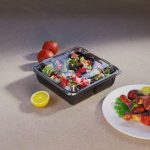
Leafy salad takes up a lot of space and does not tolerate pressure. Use a deep, round bowl with a locking lid, and send the dressing in a separate sauce cup.
Desserts
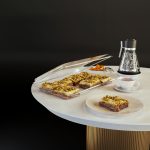
Milk puddings such as Turkish rice pudding (sütlaç) only need a small round bowl. For baklava, a wide tray with a locking lid holds the pieces in place, and the PET body resists the sugar syrup.
Sushi
Height is critical for a sushi container; Dipack sushi containers are 50 mm high, so they carry maki rolls without crushing them. Choose the size by piece count: for example, the small container holds 6-8 pieces and the large one 12-16.
Breakfast
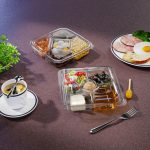
On a Turkish breakfast plate, cheese, olives, jam and butter should not touch each other. Use a 5-compartment container: H30 suits a flat arrangement and H55 suits heaped portions.
How do you keep saucy dishes leak-proof?
A locking lid keeps the container leak-proof, but the lid alone is not enough without correct filling. The locking lid sits in the channel around the container rim and snaps shut along its whole edge. As a result, a container that tilts in the courier bag keeps the sauce inside.
Keep liquid away from the lid channel. Fill the food to about 1 cm below the rim and wipe off any spilled sauce. Then press the lid down at all four corners, because a lid pressed at one corner stays open at the opposite corner.
What is the Dutch-style container for?
The Dipack Dutch-style model is a series of clear PET leak-proof containers with a square base, low profile and wide opening. The series uses the same 135 × 135 mm base in 250, 375 and 500 cc volumes. The wide opening speeds up filling, and the flat locking lid prevents leaks in transit.
The series is PET, however, so it is not suitable for hot food. Use Dutch-style leak-proof containers for cold meze, cacık (a yogurt and cucumber dip), salads and milk puddings.
How do you manage heat and steam with hot food?
Put hot food in a PP container and let the steam escape briefly before you close it. PP keeps its shape during hot filling, so the locking lid seats properly. If you close boiling food right away, however, the steam condenses into water inside the lid.
This water softens fried food, börek (filled flaky pastry) and other crispy items. Keep anything that must stay crisp away from wet side dishes. With rice pilaf and stews, steam is not a problem; a closed container actually keeps them warm.
A PP container also helps if the customer will reheat the meal at home. We do not repeat the microwave rules here; for details, see our PP vs PET container comparison.
How do you combine compartment containers with sauce cups?
A compartment container separates solid items, while a sauce cup keeps liquid on its own. Used together, they deliver the meal without mixing.
In a compartment container, however, the lid does not seal each compartment separately. When the container tilts, a runny sauce flows into the next compartment; salad dressing, for example, runs into the rice.
Thick dips and fruit, which barely flow, cause no problem in a compartment. Put runny sauces, yogurt and cacık in a sauce cup with a lid instead.
In practice, a 20-30 cc cup is enough for a single portion of ketchup or soy sauce. For salad dressing and yogurt, a 50-120 cc cup is usually right. Place the sauce cup next to the main container in the bag, so it puts no load on the lid.
How should you stack containers in a delivery bag?
Plan stacking around containers that share the same base size. Containers with the same base sit squarely on top of each other, so they do not slide or tip over in the bag.
For example, in the Dipack Eco, Lux and PP series, the 250 and 375 cc containers share a 125×107 mm base. The 750 and 1000 cc containers also share a base of about 193×128 mm. You can therefore stack different portion sizes in a single column.
- Put heavy and saucy containers at the bottom, and light, dry items on top.
- Use flat-lid containers in the middle of the stack; put dome-lid containers on top, because a dome lid offers no flat surface.
- Keep soup and stews upright, and choose a bag wide enough to support the container base.
- Do not put hot and cold items in the same bag compartment; salad in particular warms up.
What container size (cc) do you need for each portion?
Measure the portion, then add headspace below the lid and choose the container. One cc equals one milliliter. Treat the catalog cc value as the total volume of the container, because a container filled to the brim will not lock.
| Food | Starting volume (general guideline) |
|---|---|
| Ketchup, mayonnaise, soy sauce | 20-50 cc |
| Salad dressing, yogurt | 50-120 cc |
| Meze, hummus | 150-250 cc |
| Soup, single portion | 375-500 cc |
| Rice pilaf, side dish | 375-500 cc |
| Main dish, single serving | 750-1000 cc |
| Sharing portion | 1250-2000 cc |
These ranges are only a starting point, so test them with your own portions. Two containers of the same volume also behave differently. A wide, low container suits grilled food better, while a deep one suits soup.
The Dipack leak-proof series run from 150 cc to 2000 cc, so you can pick a size close to your portion.
How do container appearance and seals affect brand perception?
A clear container and a solid seal build trust before the customer opens the package. A clear PET body shows salad, dessert and sushi with the lid closed. The customer recognizes the order at first glance; in a display case or on a supermarket shelf, that visibility is the sale itself.
A seal, on the other hand, proves the package was not opened on the way. The most common method is a label or tape across the lid joint or the bag opening. The industry calls a closure that tears or leaves a mark when opened a tamper-evident closure.
If you print your brand name and order details on the label, the seal also works as a promotional tool. The label is independent of the container type, so you can offer branded delivery with a standard container.
How do you plan carton quantities and storage?
Base your stock plan on the carton data on the product page, not on estimates. Every Dipack product page shows pieces per sleeve, pieces per carton, carton dimensions and carton volume. These figures tell you how many cartons to buy and how much storage space to set aside.
Example: carton calculation for 1000 pieces
| Product | Pieces per carton | Carton volume | For 1000 pieces |
|---|---|---|---|
| 750 cc PP hot food container | 300 | 0.121 m³ | 4 cartons (1200 pieces), about 0.48 m³ |
| 3-compartment microwave food container set | 200 | 0.118 m³ | 5 cartons, about 0.59 m³ |
| 500 cc Dutch-style leak-proof container | 600 | 0.108 m³ | 2 cartons (1200 pieces), about 0.22 m³ |
| 80 cc sauce cup and lid | 1000 | 0.047 m³ | 1 carton, about 0.05 m³ |
For example, 1000 sauce cups fit in one carton, while the same number of food containers takes four cartons. Work out weekly consumption product by product and order in full-carton multiples.
Product pages also list cartons per 40' HC container and cartons per truck. For an example, see the 750 cc PP hot food container page.
Pieces per sleeve and hygiene
Pieces per sleeve also helps your hygiene plan. Open only as many sleeves as you will use in one shift, so dust and moisture do not build up in an open carton.
Let us put together a container list for your menu. Send us your dishes and daily order volume; our team will reply with samples, a carton plan and a quote.
Request a quote on WhatsApp Contact formHow do you test takeaway containers before a bulk order?
Approve a container with a trial using your own food, not with the catalog. The four steps below are quick and prevent a wrong order.
- Fill with a real portion: start with the menu item that has the most liquid and the most components.
- Wait out the delivery time: keep the container in a courier bag for the real route time.
- Tilt and stack: lay the container on its side, then put two full containers on top.
- Open and inspect: look for leaks at the lid edge, water drops inside the lid and crushed food.
If you find a problem, first change the fill level and the steaming time. If the problem continues, change the container type; that is why you should request samples before a bulk order.
Common mistakes when choosing takeaway containers
Most mistakes come from a wrong match, not from the container itself. Check these six points before you order.
- Putting sauce in a compartment: when the container tilts, sauce flows into the next compartment, so use a sauce cup with a lid.
- Filling the container to the brim: food gets into the lid channel and the lid does not lock.
- Closing boiling food right away: steam condenses on the lid and softens crispy food.
- Putting hot food in a PET container: PET loses its shape under heat, while PP keeps its form during hot filling.
- Buying a different base size for every product: stacking fails and your lid stock grows.
- Ordering without checking the carton data: you run out of storage space and end up placing unplanned top-up orders.
Frequently asked questions about takeaway containers
What is the best container for takeaway food?
There is no single best container; the choice depends on the food. For hot and saucy dishes, a PP container with a locking lid comes first. For cold and display products, use a clear PET container.
What size container do you need for soup?
For a single portion of soup, a 375-500 cc PP container with a locking lid is usually a good starting point. Still, empty your own ladle portion into the container and check the headspace below the lid.
How much empty space should you leave in a container?
Leave about 1 cm between the food and the lid. The sauce then does not reach the lid channel, and the lid locks fully.
What should you prioritize in online order packaging?
With online orders, food travels longer with the courier. A locking lid, a shared base size and a tamper-evident label therefore come first.
How many container sizes should a restaurant stock?
Split your menu into four groups: sauces, meze, single portions and sharing portions. One or two sizes per group are usually enough. A shared lid also cuts stock: for example, six Dipack hummus container volumes use the same Ø101 lid.
What supplies does a takeaway business need?
The basic list is containers, lids, sauce cups, cups, carrier bags and seal labels. Most businesses also add cutlery sets and napkins.
Should kebab go in a compartment container or a single-compartment one?
A compartment tray is the better choice for a kebab platter, because the meat, rice pilaf, vegetables and salad stay in separate compartments. For example, the Dipack 4-compartment PP kebab container measures 420 × 300 × 53 mm.
Is a label a good alternative to logo printing?
Yes, a label is a flexible solution for varying order quantities. It carries your brand and also works as a seal. For businesses that want a unique shape, Dipack offers custom manufacturing with a customer mold.