
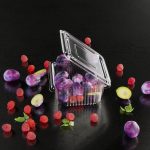
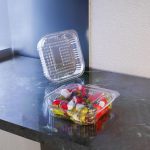
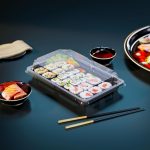
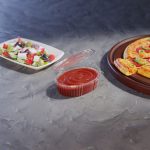



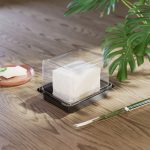

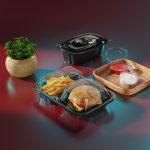


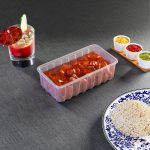



Thermoforming is a process that heats a plastic sheet and presses it onto a mold with vacuum or compressed air. The cooled part keeps the mold's shape, and a trimming station cuts it from the sheet. Food containers, lids, cups, egg trays and blister packs are typical thermoformed products.
This guide walks through the seven production steps, from the sheet roll to the carton. You will also find the difference between vacuum and pressure forming, how molds are made and a table comparing thermoforming with injection molding. The last section shows examples from the thermoforming production Dipack has run since 2008.
What is thermoforming?
Thermoforming means shaping plastic with heat: the word joins "thermo" (heat) and "forming" (shaping). The manufacturer first heats a thermoplastic sheet, then draws it into or over a mold. Once the part cools, it holds the mold's shape, so a multi-cavity mold produces several containers in every cycle.
The process stands out for thin-walled products. The industry usually calls work with sheet thinner than 1.5 mm thin-gauge thermoforming. Food containers, lids, cups and blister packs belong to this group, while refrigerator liners are heavy-gauge work.
How is thermoformed packaging made?
Food container production runs in seven steps: sheet extrusion, heating, forming, cooling, trimming, stacking and packing. On roll-fed lines, the steps from heating to stacking usually run one after another on a single thermoforming machine.
1. Sheet extrusion: preparing the sheet roll
The process starts with resin pellets. The extruder melts PET or PP pellets and pushes the melt through a flat die to draw a continuous sheet. Chill rolls then fix the sheet's thickness and surface, and a winder turns it into a roll.
Sheet thickness also sets the wall thickness of the container. During forming, the sheet stretches and gets thinner, and at no point does it exceed its starting thickness. That is why the manufacturer chooses the sheet by calculating the wall thickness that will remain in the deepest corner of the container.
2. Heating: bringing the sheet to forming temperature
First, the machine unwinds the sheet from the roll and carries it into the oven on chains. Heaters in the oven then bring the sheet to forming temperature. The main goal here is to bring every point of the sheet to the same temperature.
The temperature depends mainly on the material. Sources usually give 150-170 °C for PP and, depending on the source, ranges between 100 and 160 °C for amorphous PET (APET). These are general values, because the actual setting depends on sheet thickness, mold depth and the machine.
An overheated sheet sags and thins too much at the corners. An underheated sheet, on the other hand, does not fill the mold completely; it also shows whitening and cracks at the corners.
3. Forming: vacuum and compressed air
The softened sheet then moves to the forming station. The mold closes, and vacuum pulls out the air between the sheet and the mold, drawing the sheet tight against the mold surface. In pressure forming, compressed air from the opposite side also pushes the sheet into the mold.
For deep containers, the machine often uses a plug assist. The plug stretches the sheet mechanically before forming, so material reaches the base and corners more evenly.
4. Cooling: setting the shape
The container starts to cool as soon as it touches the mold. Aluminum conducts heat quickly, so the container hardens fast; cooling channels inside the mold also keep the mold temperature stable. If the part leaves the mold before it is rigid enough, however, it loses its shape.
5. Trimming: in-mold trimming or a separate press
There are usually two ways to cut the cooled containers from the sheet. In in-mold trimming, the knife works in the same station where forming takes place, so the container and the cut line stay exactly aligned.
With a separate press, the sheet moves on to a trimming station after forming. There, a steel rule die or a matched metal die cuts the containers. Product geometry, material and machine type usually decide which method fits.
6 and 7. Stacking and packing
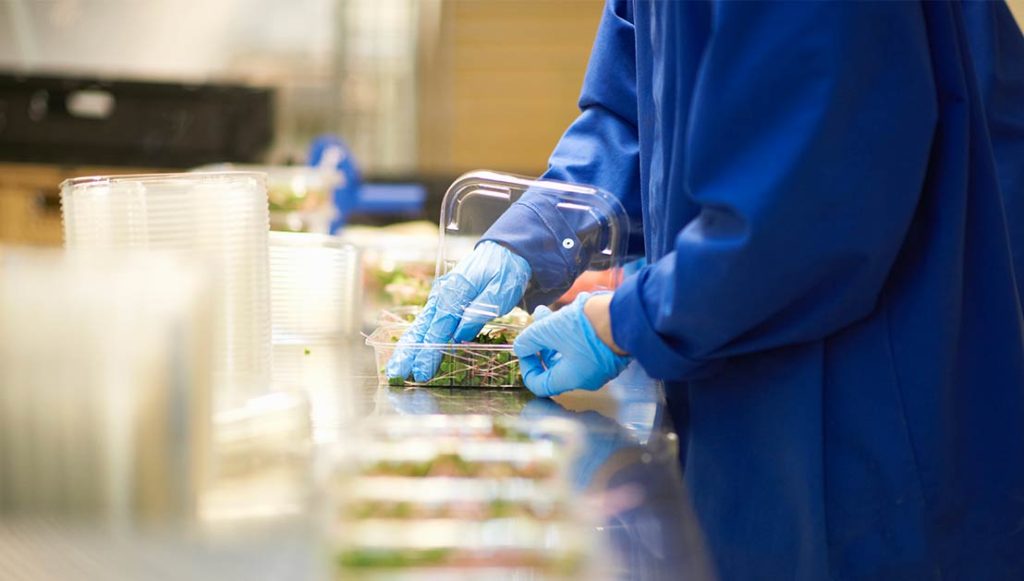
The trimmed containers move to the stacking unit, where the machine counts them and stacks them. An operator or an automatic system then places the stacks into sleeves and the sleeves into cartons. Finally, the cartons go onto pallets and out for shipment.
At this point, the carton layout also drives logistics cost. Dipack product pages, for example, show pieces per carton, carton dimensions and the number of cartons per 40' HC container and per truck. Buyers can therefore plan the load before they order.
What is the difference between vacuum forming and pressure forming?
In vacuum forming, only atmospheric pressure pushes the sheet onto the mold; in pressure forming, compressed air from the opposite side joins in. As a result, pressure forming gives sharper corners, crisper detail and tighter tolerances.
| Property | Vacuum forming | Pressure forming |
|---|---|---|
| Force pushing the sheet | Vacuum (atmospheric pressure) | Vacuum plus compressed air from the opposite side |
| Detail and corner sharpness | Medium | High |
| Typical dimensional tolerance (general value) | ±0.5-1.5 mm | ±0.3-0.8 mm |
| Investment (relative) | Lower | Higher |
| Suited for | Shallow trays, blister packs, simple shapes | Detailed containers and lids, locking and snap-fit areas |
On food packaging lines, the two methods often work together. The locking area of leak-proof containers, for example, needs the sheet to seat fully in the mold, so manufacturers add compressed air support to the vacuum.
How is a thermoforming mold made?
Toolmakers usually machine thin-gauge thermoforming molds from an aluminum block. A single mold surface defines the part's shape: the sheet sits either inside a female mold or over a male mold.
Because aluminum conducts heat quickly, the container cools fast in the mold and the cycle gets shorter. Compared with a two-half steel injection mold, a thermoforming mold is also simpler in structure, so the tooling investment is lower.
What does the mold shop do?
The mold shop machines the technical drawing into a mold. It then drills the vacuum holes, adds the cooling channels and fits the cutting knife to the mold. A manufacturer with its own mold shop can fix a problem found at the sample stage without sending the mold out.
Samples and trial production
Before series production, the mold goes through a trial run. During this run, the team checks wall thickness, how the lid lock seats and how the containers stack. The customer then tests the samples on their own filling line and on the shelf; series production starts after approval.
Which materials can be thermoformed?
The most common thermoforming materials in food packaging are PET, PP and PS. Other thermoplastics such as PVC, PE, ABS and PLA can also be shaped this way.
| Material | Key property | Typical thermoformed product | Forming temperature (general range) |
|---|---|---|---|
| PET (APET) | Glass-clear, rigid | Salad and dessert containers, cups, blister packs | About 100-160 °C, depending on the source |
| PP | Heat-resistant, flexible, semi-transparent | Hot food and microwave containers | About 150-170 °C |
| PS | Forms easily, brittle | Trays, hinged containers | About 130-160 °C |
We took the temperatures in the table from machine manufacturer and sheet supplier sources, so they are general ranges. Each manufacturer sets the actual value for its own sheet and mold during trial production.
In packaging, the product's serving temperature decides between PP and PET. We cover this comparison in detail in our PP vs PET guide.
Thermoforming vs injection molding: what is the difference?
Thermoforming seats a ready-made sheet onto a single mold surface; injection molding forces molten plastic into a closed, two-half mold. That is why thermoforming leads in thin-walled containers and trays, while injection molding leads in thick and complex parts.
| Criterion | Thermoforming | Injection molding |
|---|---|---|
| Raw material | Sheet on rolls or cut sheets | Pellets |
| Wall thickness | Thin; thinner at the corners because the sheet stretches | Set by the mold; different wall thicknesses possible in the same part |
| Dimensional tolerance (general value) | About ±0.3-1.5 mm | About ±0.05-0.2 mm |
| Mold structure | A single mold surface defines the shape, mostly aluminum | Two halves, mostly tool steel |
| Mold cost (relative) | Lower | Higher |
| Time from mold to series production | Shorter | Longer |
| Material scrap | Higher, due to edge trim scrap | Lower |
| Typical products | Food containers, lids, cups, egg trays, blister packs, trays | Screw caps, buckets, crates, technical parts |
In short, thermoforming leads in thin, lightweight food packaging. For parts that need screw threads, thick walls or precise snap fits, however, injection molding is the better fit.
What is thermoforming trim scrap, and how is it recycled?
After trimming, the grid-shaped part of the sheet left between and around the containers is called trim scrap, or the skeleton. Thermoforming produces this scrap by its nature, because the mold does not use the whole sheet.
The scrap rate depends mainly on the product and the mold layout. One source, for example, puts typical trim scrap at 20-40%; this too is a general value.
Manufacturers grind the scrap in a granulator, then feed it back into sheet production or pass it to recycling companies. This way, clean and uniform scrap becomes sheet again. Using recycled material in food-contact packaging, however, is subject to separate regulatory requirements.
The most effective way to reduce scrap is at the design stage. Placing the mold cavities well across the sheet width and narrowing the gaps between them, for example, gets more containers out of the same sheet.
How does custom thermoformed product development work?
Custom product development runs in five steps: technical drawing, mold, sample, approval and series production. Each step builds on the output of the one before it, so clear size and usage information at the start speeds up the work.
- Technical drawing: product dimensions, fill weight, lid type and stacking height go into the drawing.
- Mold: the mold shop turns the drawing into an aluminum mold and sets the number of cavities.
- Sample: trial production yields the first containers; the team measures wall thickness and the lock.
- Approval: the customer tests the sample on the filling line, in the refrigerator and on the shelf.
- Series production: after approval, the line moves to regular production and a carton plan.
This list is a general framework, because every product has its own timeline. See the custom packaging page for what Dipack does in custom manufacturing and what information it needs for a quote.
Developing a thermoformed container in your own size? Tell us about your product and monthly volume; our team will get back to you about the mold and sample process.
Request a quote on WhatsApp Contact formThermoforming at Dipack
Dipack has produced food packaging by thermoforming since 2008. The company started that year in Istanbul under the name Onur Vakum and was restructured as Onursan Ambalaj in 2016.
Production runs on PET and PP at the factory in the Dursunbey Organized Industrial Zone (OSB) in Balıkesir; the head office is at Beylikdüzü OSB in Istanbul. We design molds in our own mold shop and also run custom production with customer molds. The facility is BRCGS certified, and our products reach customers across Turkey and in more than 30 countries.
Over time, the product range has grown to more than 190 products in 20 product families. PP hot food containers, PET cups, egg trays and cake containers, for example, are all products of the same process. See the about us page for the company's history and the Dipack catalog for all dimensions.
Thermoforming: frequently asked questions
What does thermoforming mean?
Thermoforming means shaping with heat. In other words, it is the manufacturing process that heats a plastic sheet and shapes it on a mold.
What raw material is used in thermoforming?
The raw material is thermoplastic sheet, supplied on rolls or as cut sheets. PET, PP and PS sheet lead in food packaging; PVC, PE and PLA can also be thermoformed.
What does a thermoforming machine do?
The machine first heats the sheet, then forms, trims and stacks the parts. Roll-fed models run these steps one after another on a single line.
Is thermofoil the same as thermoformed packaging?
No. Thermofoil is a furniture finish: on thermofoil cabinet doors, a press heats a PVC film and vacuum-wraps it over an MDF panel. In packaging, the sheet itself takes the shape of the container; the two processes only share heat and vacuum.
What is vacuum formed packaging?
Vacuum formed packaging is a container, tray or blister pack made by vacuum drawing a heat-softened sheet onto a mold. It is the most common type of thermoforming; for work that needs fine detail, manufacturers add compressed air support.
Are thermoformed containers microwave-safe?
The material decides this, not the process. PP containers are suitable for microwave reheating, while PET containers are not.
Why are thermoforming molds made of aluminum?
Aluminum conducts heat quickly and is easy to machine. As a result, the container cools fast in the mold, and the mold is ready sooner than a steel mold.
Is thermoformed packaging recyclable?
In terms of material, yes; PET and PP are thermoplastics that can be melted and reprocessed. The result, however, depends on the local collection and sorting system; the code on the bottom of the container (1 for PET, 5 for PP) makes sorting easier.