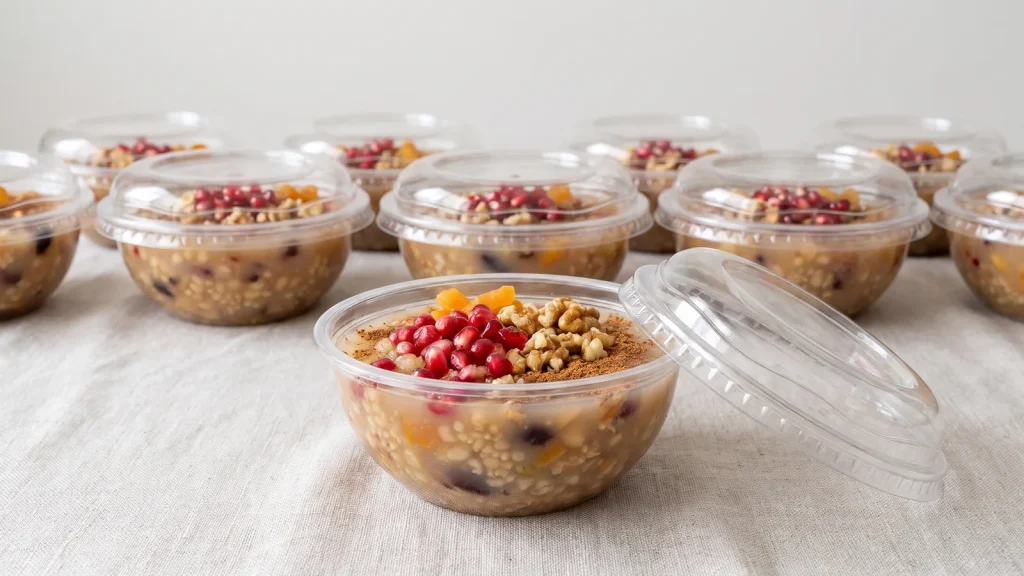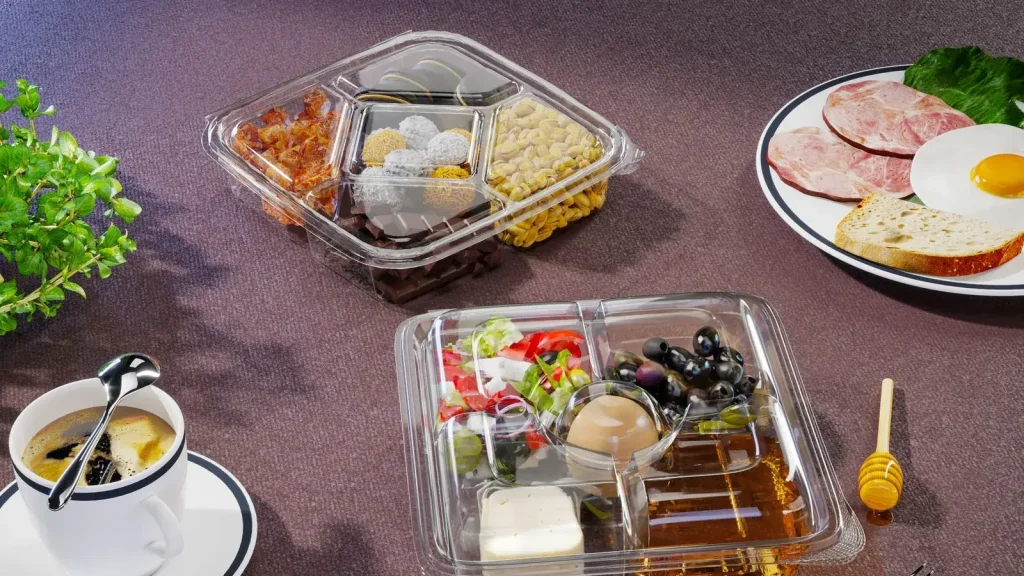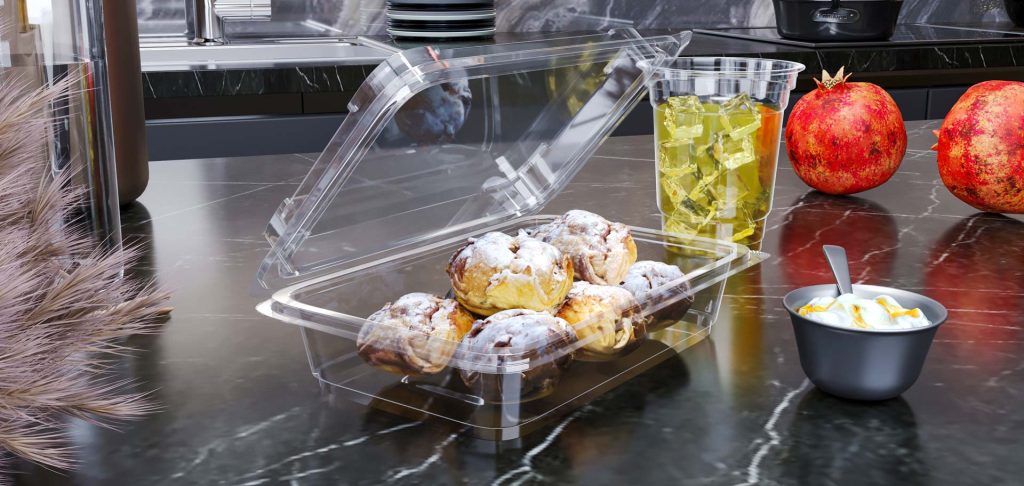













Short answer: for a single takeout portion of rice, a 500 cc PP hot food container is enough. If the rice travels with a main dish, choose a two-compartment microwave set; for set menus and packed lunches, choose a three-compartment container. Rice served as a side with kebab goes into a compartment kebab container or a 250 cc PP leak-proof container.
We wrote this guide for rice shops, restaurants, catering kitchens and organizations that serve rice at charity meals and large events. First we match the container shape to the role of rice on the menu. Then we cover portion size, steam, delivery, microwave reheating and carton planning one by one.
Which container is best for takeout rice?
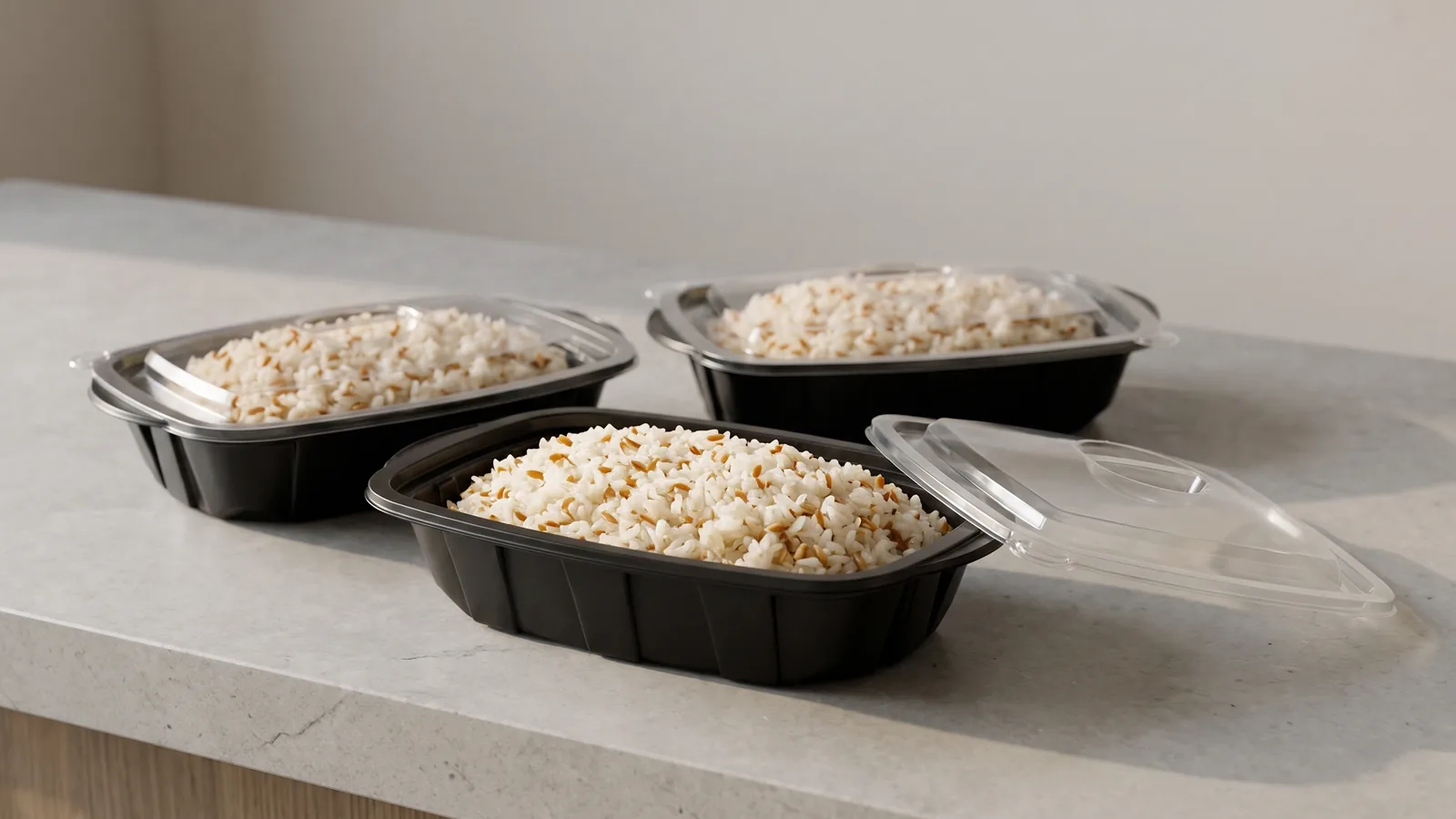
Rice is packed hot, so the container should be PP: a PP body withstands heat up to 120 °C and keeps its shape. The shape of the container depends on the role of rice on the menu: on its own, next to a main dish or as a side.
| Role on the menu | Recommended container | Volume / compartments | Material |
|---|---|---|---|
| Plain rice, chicken or chickpeas over rice | New model PP food container | 500 / 750 / 1000 cc | PP |
| Rice with bean stew, meat or chicken saute | Two-compartment microwave set, main + side | 2 compartments, 240×204×68 mm | PP |
| Set menu: main dish, rice and salad | Three-compartment microwave set | 3 compartments, 240×204×68 mm | PP |
| Packed lunch and meal box | Two- and three-compartment food container | 2-3 compartments, 227×178×43 mm | PP |
| Side rice with kebab | Four-compartment kebab container | 4 compartments | PP |
| Separate side or kids portion | PP leak-proof container, flat lid | 250 cc, 125×107×40 mm | PP |
In short, most businesses that sell rice need only two containers: a single-compartment container and a compartment set. Sizes and carton data for every model are in the PP hot food containers category.
How much rice fits in a 500 cc container?
Cooked rice filled without pressing weighs about 0.7-0.8 g per cc, so a 500 cc (500 ml) container holds 350-400 g of rice. For rice bowls with a topping, leave extra room for the chicken or chickpeas on top.
- Side and kids portion (150-200 g): 250 cc PP leak-proof container.
- Single portion of plain rice (250-350 g): 500 cc food container.
- Chicken, chickpeas or doner over rice (400-500 g): 750 cc food container.
- Large portion or a pack for two (600 g and above): 1000 cc food container.
However, the type of rice changes the result. For example, bulgur pilaf and rice with orzo stay fluffy, while buttery rice pilaf settles more tightly. So weigh your own portion in a sample container to set the exact volume.
How many portions does a pot of rice make?
Rice gains about two and a half to three times its weight when cooked, so 1 kg of raw rice gives 10-12 portions of 250 g. The table below shows approximate numbers for charity meals and large events.
| Raw rice | Cooked rice (approx.) | 250 g portions | 350 g portions |
|---|---|---|---|
| 10 kg | 25-30 kg | ~100-120 | ~70-85 |
| 25 kg | 62-75 kg | ~250-300 | ~180-210 |
| 50 kg | 125-150 kg | ~500-600 | ~350-430 |
The math is simple: divide the cooked rice weight by the portion weight. Also, round the result down by five percent for the rice left in the pot and on the ladle. That way you never run short of containers or rice at the end of service.
Should rice share a container with the main dish?
Put rice in its own compartment when it travels with a saucy dish, because the sauce soaks the rice and turns it mushy. With dry dishes such as meatballs or grilled chicken, rice and meat travel well in the same compartment.
For example, a bean stew and rice menu fits a main + side microwave set. The large compartment takes the stew and the side compartment takes the rice, so the customer mixes them on the plate. In contrast, with chicken over rice the chicken already sits on the rice, so a single-compartment container is enough.
We explain how to pair compartment containers with sauce cups in our takeout container guide. For yogurt, cacik or pickles, add a separate sauce container.
How do you stop condensation in a rice container?
To stop condensation, leave the rice open in the container for a minute or two and close the lid once the steam drops. Steam from hot rice turns into droplets on the inside of the lid and wets the top of the rice.
However, containers cannot stay open for long during a busy service. Instead, fill the containers in order on the line and close the first one last. This way each container releases steam for a short time and the rice stays fluffy.
Also, fill the rice after it has rested, not straight from a boiling pot. Rested rice has absorbed its water, so less condensation forms on the lid.
How do you deliver takeout rice without spills?
Send rice in a rectangular container with a locking lid that stays flat and upright in the delivery bag. A round or shallow container tips over in the bag and the rice piles up against the lid.
Press the lid down at all four corners, because a half-closed lid opens when the bag shakes. If a rice bowl has chicken or chickpea broth, do not fill the container to the brim. That way the liquid stays away from the lid channel and does not leak into the bag.
Finally, put heavy and saucy containers at the bottom and the rice container on top. Our takeout container guide covers stacking in the delivery bag step by step.
Can you microwave rice in the container?
You can reheat rice in a PP-bodied container in the microwave, because polypropylene handles the heat and keeps its shape. Before reheating, remove the clear lid and sprinkle a few drops of water over the rice.
Buttery rice pilaf hardens as it cools and the grains dry out. When you sprinkle water and cover the container loosely, the steam softens the grains again. So add a short reheating note to the menu card or the label.
Ready meal producers also use PP containers in the freezer. We compare PP and PET in our PP vs PET guide.
Plastic or paper containers for rice?
For takeout rice, a PP container with a locking lid has a clear advantage: PP does not absorb grease or steam, so the container does not get soggy. In addition, the clear lid shows the rice to the customer before the pack is opened.
For example, buttery rice and chicken over rice leave grease behind. A PP container keeps that grease on its surface and holds its shape until delivery. Moreover, the customer reheats the rice in the same container, so no second dish is needed.
How do you plan cartons for a large rice order?
Work out cartons from the number of portions: one carton of 500 cc food containers covers a 300-portion event. For 400 packed lunches, one carton of two- or three-compartment food containers is enough.
| Container | Pieces per bag / carton | Carton dimensions (mm) | Carton volume |
|---|---|---|---|
| 500 / 750 / 1000 cc PP food container | 50 / 300 | 640×415×455 | 0.121 m³ |
| One-, two- and three-compartment microwave set | 100 / 200 | 600×410×480 | 0.118 m³ |
| Two- and three-compartment food container | 50 / 400 | 580×370×470 | 0.101 m³ |
| 250 cc PP leak-proof container | 100 / 1000 | 920×250×530 | 0.122 m³ |
| Four-compartment kebab container and lid set | 25 / 100 | 560×310×425 | 0.074 m³ |
Add a ten percent reserve to your count and keep unopened bags for the next order. For warehouse and vehicle planning on large orders, see our container and carton calculation guide. For menus with side rice, browse the kebab containers, and for side portions the PP leak-proof containers category.
Choose your rice container with a sample. Tell us your menu, portion weight and daily order volume; our team will send a matching container or set sample with carton data.
Request a quote on WhatsApp Contact formHow does Dipack make its rice containers?
Dipack makes its PP food containers by thermoforming at its factory in Dursunbey OSB, Balıkesir. In this process a heated sheet takes its shape in the mold, so the container and lid come out the same size in every batch and the lock fits securely. We explain the production steps in our what is thermoforming guide.
The factory is BRCGS certified and Dipack exports to more than 30 countries. The head office is in Beylikdüzü OSB, Istanbul.
Rice takeout containers: frequently asked questions
What container is used for takeout rice?
For a single portion of rice, a 500 cc PP hot food container is enough. If the rice goes with a main dish, choose a two-compartment microwave set.
How many grams is one portion of rice?
A takeout portion is usually 250-350 g. A side portion is around 150-200 g, and a rice bowl with a topping is around 400-500 g.
Can hot rice go into a plastic container?
Yes, you can put hot rice into a PP container. Polypropylene withstands heat up to 120 °C and keeps its shape during hot filling.
How many portions does 1 kg of rice make?
Rice gains about two and a half to three times its weight when cooked. So 1 kg of raw rice gives 10-12 portions of 250 g.
How do I stop condensation in rice containers?
Leave the rice open in the container for a minute or two, then close the lid. Filling rice after it has rested also reduces condensation on the lid.
Can rice and bean stew go in one container?
In a main + side set, both travel in the same pack but in separate compartments. That way the stew does not soak the rice.
Are food containers microwave-safe?
You can use a PP-bodied container in the microwave. Remove the clear lid before reheating and sprinkle a little water over the rice.
Does Dipack send samples of rice containers?
Yes, we send samples of the container or set you choose. You test it with your own portion first and then move to a wholesale order.