


















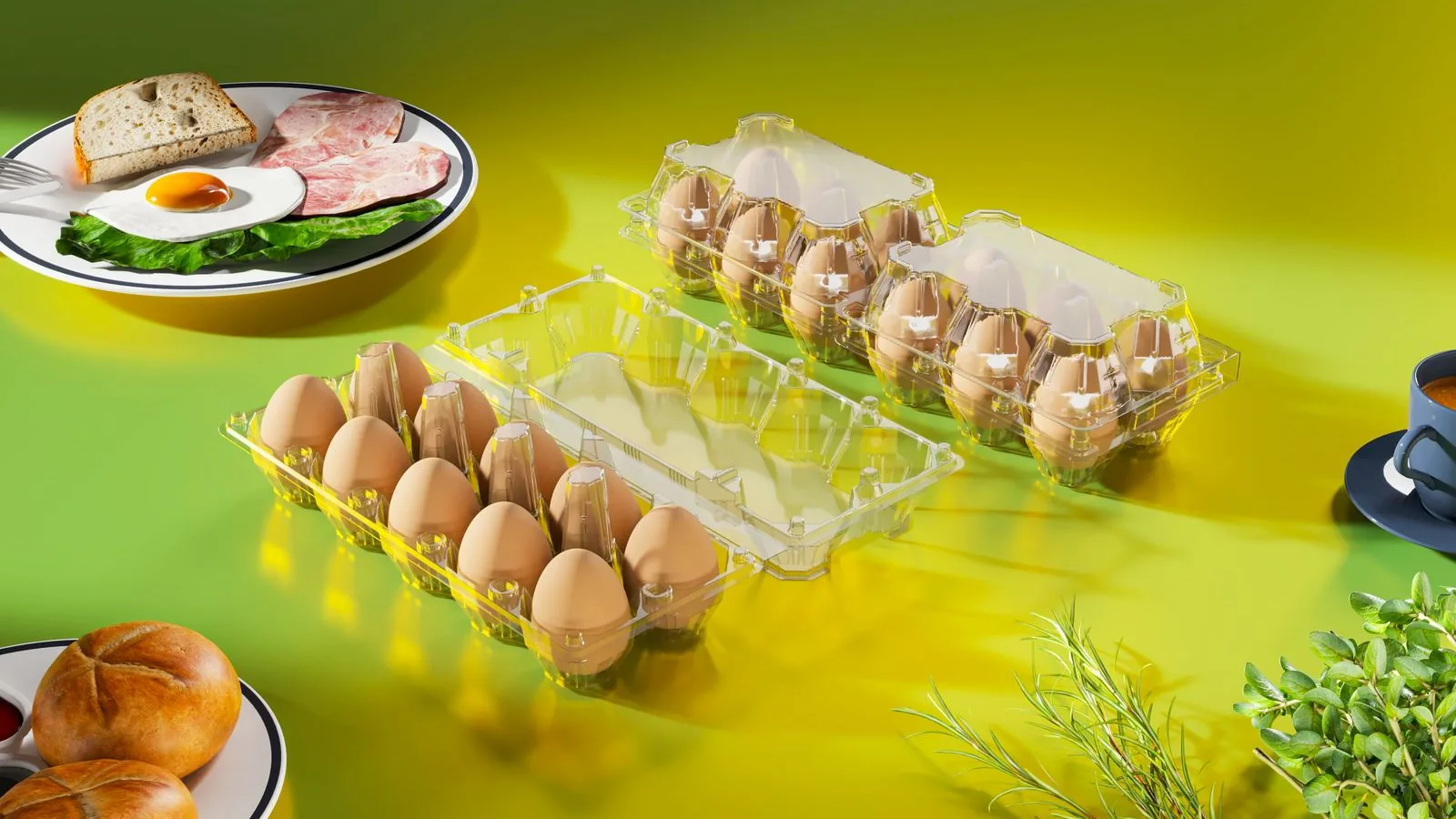
Short answer: an egg carton holds each egg in its own cell. That way, eggs travel and sell without cracking. You can choose from three main types: pulp, plastic (PET) and foam. For shelf visibility and moisture resistance, pick a clear PET carton with a locking lid.
We wrote this guide for egg producers, packing stations and grocery buyers. First, we compare carton types in one table. Then we cover what decides a purchase: count, cell size, label space and loading.
What is an egg carton and what does it do?
An egg carton gives every egg a separate cell. As a result, eggs do not knock together, so fewer eggs crack in transit.
A carton has three jobs. First, it protects the eggs from the farm to the shelf. Second, it sets the sales unit, such as a pack of 10 or 15. Finally, it carries the required label to the shopper.
In Turkish, the word for an egg carton is "viyol." However, farmers use the same word for seedling trays, so the two often mix in search. This guide covers egg cartons only.
What types of egg cartons are there?
By material, egg cartons fall into three groups: pulp, plastic (mostly PET) and foam. Each one fits a different need. So the right choice depends on where you sell the eggs.
| Feature | Molded pulp | Plastic (PET) | Foam |
|---|---|---|---|
| Are the eggs visible? | No, not with the lid closed | Yes, the lid is clear | Usually no |
| Moisture and cold rooms | Absorbs moisture, softens when wet | Keeps its shape in humidity | Resists moisture |
| Closure | Tab and slot | Locking lid, stays shut in transit | Lock or tab |
| Label surface | Matte, good for printing | Flat lid, good for labels | Textured surface |
| Impact protection | Fibers absorb shocks | Cell shape holds eggs in place | Light structure absorbs shocks |
| Recycling | Paper stream | No. 1 PET stream | Needs separate collection |
| Typical use | Bulk shipping, trays | Retail shelf, farm eggs, deli counters | Some imported and specialty packs |
In short, pulp is common for bulk shipping. PET, on the other hand, stands out in retail. There, shoppers pick eggs by looking inside. We explain what plastic numbers mean in our plastic recycling codes guide.
Why do grocery stores prefer plastic egg cartons?
A plastic egg carton shows the eggs without the shopper opening the lid. Therefore, the shopper spots a cracked egg on the shelf. As a result, nobody has to open the pack.
This has practical effects in the store. For example, fewer packs get opened, so breakage and returns go down. In addition, the locking lid keeps the pack shut in the cart or the shopping bag.
PET also stays firm when it moves from a cold room to a warm store. You may see brief fogging on the surface, but the body keeps its shape. We cover how clear packaging affects sales in our clear plastic food containers article.
How many eggs does a carton hold?
Retail egg cartons usually hold 6, 10, 12 or 15 eggs. For bulk shipping, open 30-egg trays (egg flats) are common.
- 10-egg carton: a standard retail pack in many markets. So first orders often start here.
- 12-egg (6×2) carton: a slim pack with two rows of six. It saves space on narrow shelves.
- 15-egg carton: a family-size pack for larger households.
- 30-egg tray: a lidless bulk unit that goes to bakeries, hotels and food production.
Dipack makes 10-egg, 15-egg and 6×2 cartons. All of them are clear PET with locking lids and an 80 mm height. You can see every model on our egg cartons page.
Which egg carton fits which egg size?
Choose the cell size by the weight class of your eggs. If the cell is too tight, the lid will not lock. If it is too loose, the egg moves and knocks.
Turkey's Ministry of Agriculture and Forestry sorts Class A hen eggs into four weight classes. The limits match the EU marketing standard (Regulation (EU) 2023/2465):
| Class | Weight | What to check in the carton |
|---|---|---|
| XL (very large) | 73 g and over | Always test lid height with a sample |
| L (large) | 63-73 g | Check that the lid locks at every point |
| M (medium) | 53-63 g | The main target of a standard retail carton |
| S (small) | Under 53 g | If cells leave a gap, eggs move, so test in transit |
In practice, fill one pack with your largest class and close the lid. Then turn the pack upside down and shake it gently. If the lid stays shut and the eggs do not press on it, the cell size fits. Our step-by-step method is in the plastic container quality check guide.
What information goes on an egg carton label?
In Turkey, two rules set the egg label: the Turkish Food Codex Egg Communiqué and the Labeling Regulation. So plan the label space before you choose the carton.
For example, the communiqué puts the weight and quality class of Class A eggs on the same face as the product name. In addition, the label shows the best-before date and a fridge reminder. Check the current text and later amendments in the Official Gazette. If you export, also check the destination market.
This information does not fit on a tiny area, so the carton needs a flat label surface. On a PET carton, the flat top of the lid is the cleanest spot. Compare the label and lid sizes in advance. Then place the label so it does not cover the eggs.
Does the egg carton affect freshness?
A carton does not decide egg freshness on its own; temperature and time do. However, the right carton keeps eggs safe in the cold chain.
For instance, a locking lid separates eggs from fridge odors and outside contact. Likewise, a carton that holds its shape in humidity keeps stacks from collapsing.
An egg carton is also a food-contact material. So ask the supplier for a declaration of compliance. We list the documents in our food-grade plastic containers guide.
How do you plan cartons and storage for bulk egg carton orders?
Egg cartons are light but bulky, so volume, not weight, drives storage and shipping. Before ordering, work out carton count, volume and vehicle capacity together.
The table below uses the data on Dipack's product pages and adds the total count:
| Model | Size (mm) | Per shipping carton | Carton volume | 40 HC container | Truck |
|---|---|---|---|---|---|
| 10-egg carton | 240×100×80 | 600 pcs | 0.131 m³ | 513 cartons, 307,800 pcs | 674 cartons, 404,400 pcs |
| 15-egg carton | 240×150×80 | 500 pcs | 0.134 m³ | 501 cartons, 250,500 pcs | 658 cartons, 329,000 pcs |
| 6×2 egg carton | 300×100×80 | 400 pcs | 0.133 m³ | 504 cartons, 201,600 pcs | 662 cartons, 264,800 pcs |
For example, take a station that ships 20,000 packs of 10 eggs a week. It uses 34 shipping cartons a week, so one week of stock needs about 4.5 m³. To adapt the math, see our how many cartons fit in a container guide.
What are common mistakes when choosing egg cartons?
The most common mistake is choosing a carton by count and looks alone. In fact, most problems show up in the first truck, not on the shelf.
- Testing with small eggs: the lid closes on medium eggs but pops open on XL. So test with your largest class.
- Planning the label too late: a label that does not fit the lid covers the eggs. Therefore, set its size with the carton.
- Ignoring the cold room: packaging that softens in humidity collapses in the stack. For that reason, pick a carton that keeps its shape.
- Skipping storage volume: buyers assume light cartons take little space. Actually, one week of stock fills several cubic meters.
- Closing the lid at one point: press every locking point during packing. Otherwise, a corner opens in transit.
Test the carton with your own eggs. Tell us the pack count and egg class. Our team will send a matching sample and the carton data.
Request a sample on WhatsApp Contact formHow does Dipack make plastic egg cartons?
Dipack makes its egg cartons by thermoforming at its factory in Dursunbey OSB, Balıkesir. In this process, a heated PET sheet takes shape in the mold. As a result, every cell comes out the same size, and every lid locks the same way. We explain the steps in our what is thermoforming guide.
The factory holds BRCGS certification and designs its molds in its own workshop. The head office is in Beylikdüzü OSB, Istanbul. Dipack exports to more than 30 countries. For a different count or a branded form, see our custom containers page.
Plastic egg cartons: frequently asked questions
What is an egg carton called in Turkish?
Turkish speakers say "viyol" or "yumurta viyolü." In English, people also say egg box, egg pack or egg tray.
What are plastic egg cartons made of?
Most makers use PET for clear plastic egg cartons. Dipack uses clear, food-contact grade PET.
Are pulp or plastic egg cartons better?
They do different jobs. Pulp is common for bulk shipping. For shelf visibility, moisture resistance and a locking lid, PET works better.
How many eggs are in a carton?
Retail cartons hold 6, 10, 12 or 15 eggs. For bulk use, open 30-egg trays are common.
Do XL eggs fit a standard carton?
It depends on the cell and lid height. So fill a sample with your largest class and check every lock.
Can you put a label on a plastic egg carton?
Yes, the flat top of the lid suits a label. Place it on part of the lid so it does not cover the eggs.
Are plastic egg cartons recyclable?
PET egg cartons belong to the No. 1 plastic group and go into the PET recycling stream. Local collection rules vary by municipality.
Does Dipack send egg carton samples?
Yes, we send samples of the model you choose. That way, you test it with your own eggs before a bulk order.