



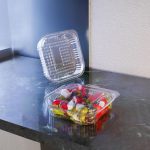
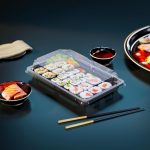
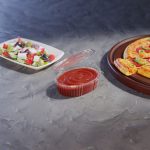
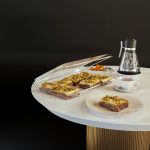
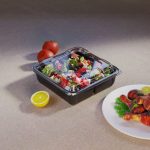
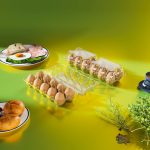
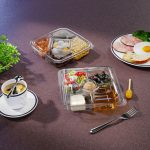
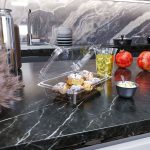
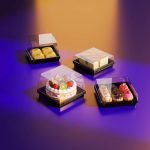
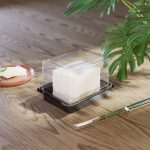

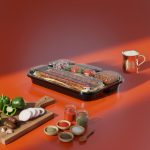
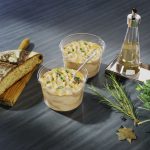
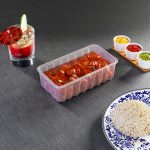

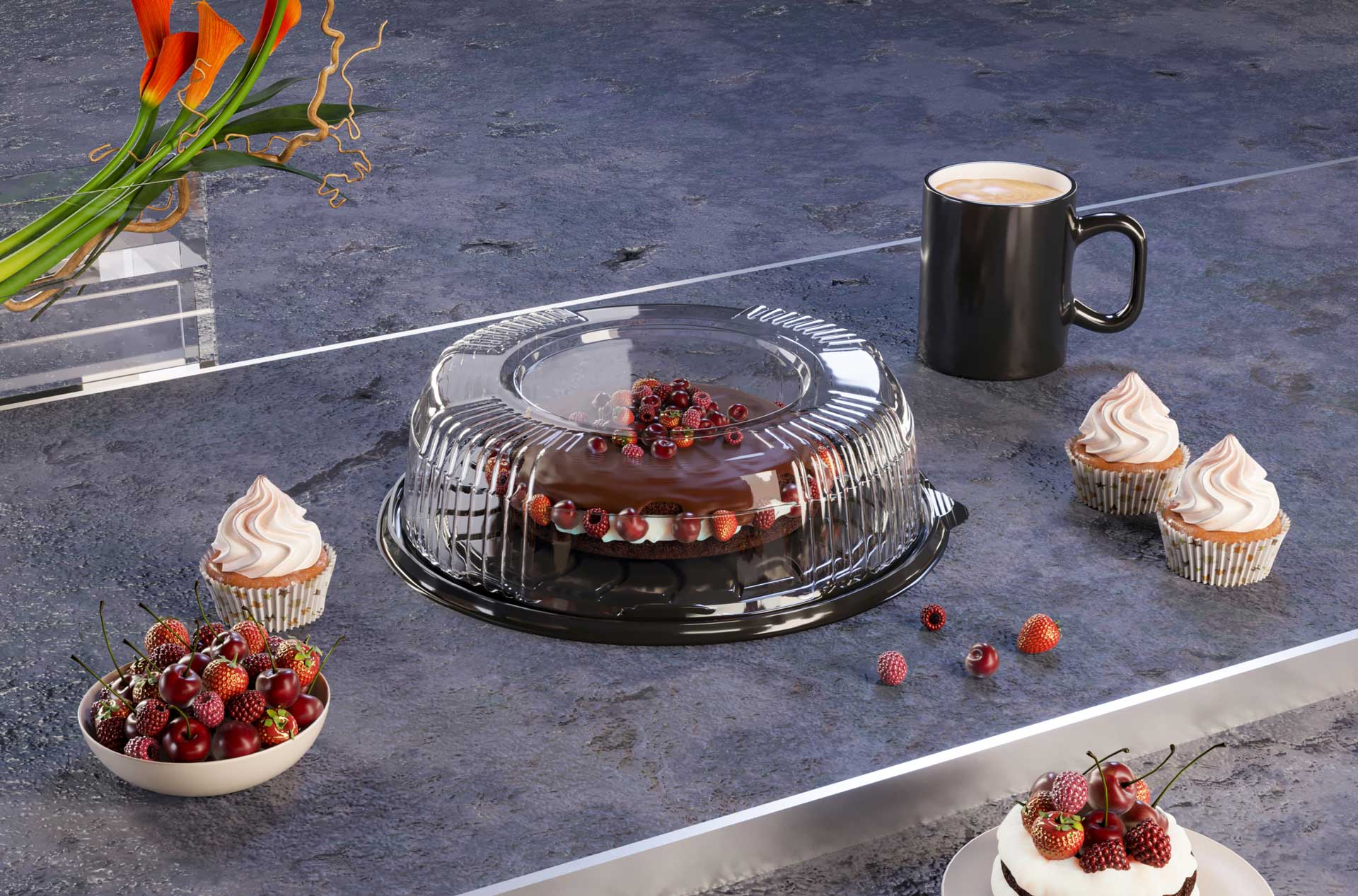
Short answer: a clear plastic food container shows the product without the customer opening the lid, so it speeds up the buying decision in the display case and on the shelf. For cold and display products, choose glass-clear PET. For hot food, translucent PP is the right choice.
We wrote this guide for bakeries, delis, dessert shops and takeout businesses. First, a table shows which products look best in a fully clear container and which work better on a colored base. After that, we cover the details that spoil the display: fogging, scratches, labels and stacking.
Why do clear plastic containers help sales?
A clear container turns the product itself into the strongest visual on the pack. The customer sees the color, the texture and the portion, so the question "what is inside" disappears.
This has three practical results. First, the customer chooses without opening the lid, so the display stays tidy and the product stays hygienic.
Second, the customer sees the portion and matches it to the price right away. Finally, if the product arrived intact, the customer sees that through the lid too, and that builds trust.
However, clarity does not lift every product equally. Colorful, layered and decorated products shine in a clear container. In contrast, plain-looking or saucy products often look more appetizing on a dark base.
Which products need a fully clear container and which suit a colored base?
The rule is simple: if color and layers sell the product, use a fully clear container; if you need contrast or variety coding, use a colored base. We built the table below around the container groups Dipack actually manufactures.
| Product | Recommended container | Why? | Dipack container group |
|---|---|---|---|
| Cake slices, cheesecake | Fully clear PET, high lid | Layers and decoration show from the side and top | Cake containers |
| Baklava, syrup desserts | Fully clear PET, locking lid | The slice layout shows, the syrup stays in | Baklava containers |
| Cookies, dry pastries | Fully clear, with or without divider | The customer picks the variety without opening the lid | Cookie containers |
| White cheese, kashar | Clear lid, clear or colored base | A colored base codes the variety without a label | Cheese containers |
| Green salad, bowls | Black bowl, clear dome lid | A dark base makes greens look fresher | Salad containers |
| Rice pudding, profiteroles, clotted cream | Clear PET leak-proof container | The surface and layers show on the shelf | Lux leak-proof containers |
| Olives, pickles, meze | Translucent PP, locking lid | Holds its shape in brine and still shows the product | Deli containers |
| Hot meals, soup | Translucent PP | Withstands heat and goes in the microwave | PP hot food containers |
In short, the table is a starting point. So always make the final call by putting your own product in a sample container and looking at it under your display lighting.
Should you choose PET or PP for a clear container?
If you want full clarity, choose PET, because PET gives a glass-clear body. PP, on the other hand, is translucent with a slight matte look, and in return it handles hot food.
- PET: cakes, baklava, cookies, salads, sauces and display desserts. The rigid body does not crush in a stack and keeps its shape in the fridge.
- PP: hot meals, soup, olives and meze in brine. The flexible body does not crack when squeezed and heats in the microwave.
So the clearest container is not always the right container. For example, if you put hot food in a PET container, the body loses its shape and the lid lock pops out. We compare the two materials in full in our PP vs PET guide.
When does a colored base work better than a clear one?
A colored base helps when you sell several varieties on the same shelf. The customer tells them apart by the base color, without reading a label.
For example, cheese producers choose black for full-fat, blue for low-fat and green for curd cheese.
For this purpose, Dipack makes its cheese container base in clear as well as black, blue, red, green, purple and fuchsia, while the lid is always clear. As a result, the customer sees the product from above and the variety from the side. You can find the options on the cheese containers page.
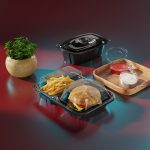
Similarly, a black bowl creates strong contrast with salad greens. That is why the square salad bowls pair a black bowl with a clear lid; see the salad containers page for sizes.
Why do clear containers fog up in the display case, and how do you prevent it?
Fog is water vapor that condenses on the inside of the lid; in other words, it comes from a temperature difference. When you close a warm product and put it in a cold display case, the vapor hits the cold lid and turns into droplets.
A foggy lid hides the product, so you lose the whole advantage of a clear container. To prevent it, follow this order:
- Let the product cool to room temperature first, then close the lid.
- Move products from the fridge straight into the cold display case, without leaving them on a warm counter.
- For high-moisture products, such as fruit cakes, leave a few millimeters of space between the lid and the product.
- Keep the display case temperature and humidity steady, because fog returns each time the door opens often.
In addition, fog is unavoidable with food served hot. So for hot food, put heat resistance ahead of clarity and choose a PP container.
How do scratches and stacking affect a clear container?
The second thing that spoils the display is surface scratches. A PET surface is crystal clear, so every mark stands out under light.
- Storage: keep empty containers in their bag and carton until filling; on an open shelf, dust and friction dull the surface.
- Stacking: place filled containers in the display by lifting them, not by sliding them over each other.
- Cleaning: do not use the abrasive cloth you use on the display glass on the containers; a soft, dry cloth is enough.
- Filling: if cream or syrup gets into the lid channel, wipe it before closing; a mark in the channel looks like a stain along the lid edge.
Besides, the body itself should be clear. Cloudy patches and flow marks point to the raw material and mold maintenance, so we explain how to check a sample in our plastic food container quality check guide.
Where should you put the label on a clear container?
Put the label where it does not cover the product: on a corner of a flat lid or on the side of the container. A label that covers the whole lid cancels the point of choosing a clear container.
A flat lid gives the cleanest surface for a label; in contrast, on a dome or high lid the label wrinkles and lifts at the edges. So compare the label size with the lid size in advance. For example, on a baklava container you can use the side wall in addition to a label on the lid; sizes are on the baklava containers page.
On the other hand, branded and decorated products often stand out without any label. For instance, a patterned cake lid gives a distinctive look in the display with no extra label; the models are on the cake containers page.
How does lid height change the display?
The total height of the product, decoration included, sets the lid height. If the lid touches the product, it crushes the decoration and leaves a mark inside the lid.
For example, a flat lid suits layered products such as baklava and white cheese. A high or dome lid, by contrast, leaves 15-30 mm of extra space for heaped salads, cream cakes and decorated desserts. As a result, the product does not stick to the lid and keeps its shape when seen from above.
Also measure the shelf spacing of your display case. If a high lid exceeds the shelf gap, you have to place containers side by side instead of stacking them, so fewer products fit in the display.
See your product in a sample container under display lighting. Tell us the product type and portion; our team will send a suitable clear container sample and the carton data.
Request a sample on WhatsApp Contact formHow does Dipack make clear containers?
Dipack produces clear containers by thermoforming at its factory in Dursunbey OSB, Balikesir. In this process, a heated PET sheet takes shape in the mold, so the body comes out thin but rigid and clear. We explain the production steps in our what is thermoforming guide.
In addition, the factory is BRCGS certified and designs its molds in its own workshop. The head office is in Beylikdüzü OSB, Istanbul. If your display needs a custom shape or size, see the custom packaging page; for a premium series aimed at shelf presentation, the Lux leak-proof containers are a good fit.
Frequently asked questions about clear plastic food containers
What material are clear plastic food containers made of?
Fully clear food containers are usually PET. Dipack makes its cake, baklava, salad, sauce and Lux leak-proof containers from clear, food-contact PET.
Why is PP not as clear as PET?
PP scatters more light because of its structure, so the body looks translucent with a slight matte finish. That is not a defect; moreover, PP withstands hot food and the microwave.
Can I put hot food in a clear container?
No, do not put hot food in a clear PET container, because the body loses its shape and the lid pops out. For hot service, choose PP hot food containers.
How do I stop lids from fogging in the display case?
Close the lid only after the product cools to room temperature, then move it straight into the cold display case. Also keep the case temperature and humidity steady.
Should I choose a colored base or a fully clear container?
If color and layers sell the product, choose a fully clear container. If you need to tell varieties apart on one shelf, or want contrast for green products, a colored or black base works better.
Can you put a label on a clear container?
Yes, a flat lid is the best surface for a label. Place it on a corner of the lid so the product stays visible.
Does a clear container turn cloudy in the fridge?
A PET container keeps its shape and clarity in the fridge. The cloudiness you see is usually fog; it clears when the product reaches room temperature or when you wipe the lid.
Does Dipack send clear container samples?
Yes, we send samples in the size and lid type that suit your product. That way, you test the container with your own product under display lighting before a wholesale order.


